Choice of material and wood type – the key to a durable and aesthetically pleasing staircase
The choice of materials and wood is crucial for a solid staircase. At Drömtrappor we use a wide range of high-quality materials that can be customized for both appearance and function. Here we look at the different materials and wood types available, their unique properties and what you can do to keep your staircase beautiful and durable.
Local pine and sustainable oak
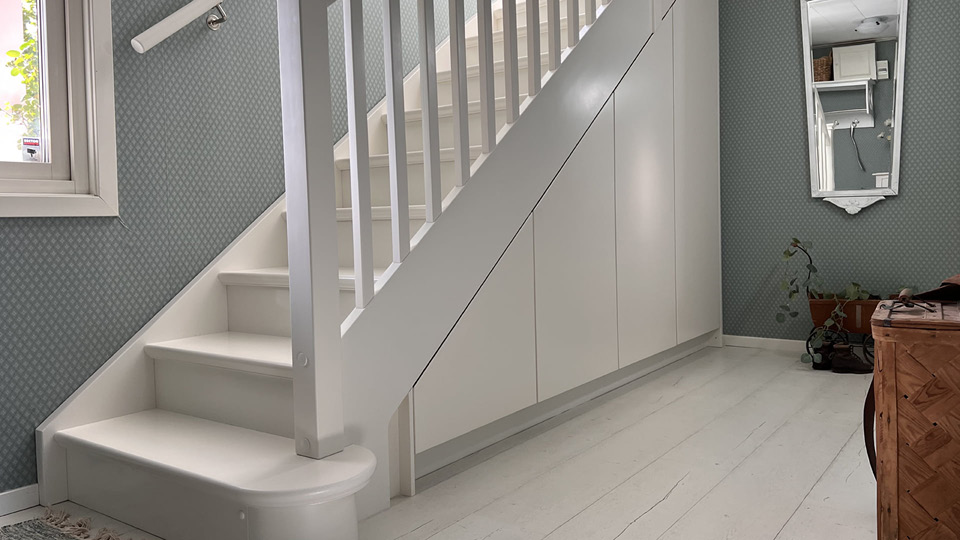
In Northern Sweden we have plenty of coniferous forests, and since we at Drömtrappor have the forest right next door, pine is a very economical option for manufacturing. Since pine has a softer character and wears out faster, it is mainly used for secondary parts of the stairs such as stringers and balusters, often in combination with oak steps to balance cost and durability. A staircase is exposed to daily rough handling, which is a big reason why most of the steps we manufacture are made of oak. Oak is a hard and durable wood, making it ideal for both floors and stairs.
Oak prices have risen in recent years due to increased demand and limited supply. Despite this, an oak staircase is a long-term investment that will last for many years. The most common combination is oak in the steps and handrails, with the rest of the staircase details in white-painted pine.
Our wood types
Oak and pine may be the most common materials, but there are many other types of wood to choose from. Our stairs are made from glued solid wood, with slats arranged in harmonious patterns throughout. The slat construction helps reduce the risk of cracks and deformation. Step undersides can be manufactured in a more cost-effective quality at the storage underside, which allows us to offer affordable stairs without compromising on durability and function.
Among the harder woods we find ash, with board material manufactured in our own factory. With its vibrant grain, ash gives a lively and solid impression. The European beech has a reddish, warm tone and is a very hard and durable wood, similar to Scandinavian birch, which in turn is well suited for those who want a completely painted staircase in solid wood.
Here you can read more about the different types of wood we use.
Surface treatment of our stairs
The stairs are surface treated during production using rational and environmentally friendly methods. It is also possible to highlight the structure of the wood by choosing treads and risers with a brushed surface. In some cases, this also highlights the surface treatment. Another advantage of a brushed surface is that the steps can be perceived as less slippery and more pleasant to walk on. However, a brushed surface is not suitable for stairs that are top-painted or have a large landing area.
Different types of wood require specific surface treatments, so contact your sales representative for more information. Topcoating is standard on MDF-clad pine frames or birch if solid wood is desired.
You can read more and see examples of surface treatment here.